This Video Is Trending Right Now →
By Boluwatife Oshadiya
Key Points:
- Dangote Refinery reportedly sells petrol below market price despite rising crude costs
- Diesel prices also being “optimised,” suggesting partial subsidy
- Aviation fuel sold at market rate as refinery limits subsidy scope
- Jet fuel prices surge over 300% amid Middle East tensions
- Airlines warn of potential shutdown over unsustainable operating costs
Main Story:
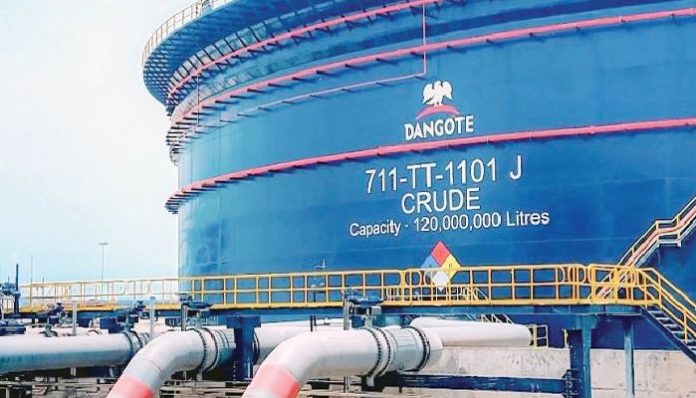
A senior official within the Dangote Group has disclosed that the Dangote Petroleum Refinery is effectively subsidising petrol and diesel supplied to the Nigerian market, even as global crude oil prices continue to climb.
The official, who spoke on condition of anonymity due to lack of authorisation, said the refinery’s current ex-depot petrol price of N1,200 per litre remains below prevailing market rates. This pricing strategy comes amid a sharp escalation in crude oil prices triggered by geopolitical tensions in the Middle East, particularly disruptions linked to the US-Iran conflict.
Global benchmark Brent crude, which traded around $66 per barrel as of February 28, surged past $100 per barrel following reports that Iran blocked the Strait of Hormuz—a critical oil transit route. The spike in crude prices has since cascaded across refined petroleum products, significantly impacting domestic fuel pricing.
In response to these market pressures, the Dangote Refinery adjusted its petrol gantry price from N774 to N1,200 per litre. Diesel and aviation fuel prices have also experienced upward revisions, reflecting broader global energy market trends.
Despite these increases, the Dangote official maintained that the refinery has absorbed part of the cost burden on petrol and diesel to cushion Nigerian consumers.
“With crude prices moving up steeply, we try to optimise the price of PMS as much as possible to help the public. To some extent, we also optimise the price of AGO. We cannot subsidise everything, so jet fuel is sold at market price,” the source stated.
When pressed further, the official confirmed that the term “optimise” effectively translates to a form of subsidy.
Aviation Sector Under Pressure
The impact of rising fuel costs has been particularly severe in Nigeria’s aviation industry, where operators are grappling with unprecedented increases in the price of Jet A-1 fuel.
The Airline Operators of Nigeria (AON) has warned that continued escalation could force airlines to suspend operations. According to AON Vice President Allen Onyema, jet fuel prices have surged from approximately N900 per litre before the Middle East crisis to between N2,700 and N2,900, with some suppliers reportedly charging as high as N3,500 per litre.
Further insights from a Dangote Group source indicate that the refinery currently sells aviation fuel to marketers at around N1,799 per litre, below the N2,000 threshold. Industry data from the Major Energies Marketers Association of Nigeria (MEMAN) previously placed Dangote’s jet fuel gantry price at N1,732 per litre, compared to N1,835 per litre for imported alternatives.
This Video Is Trending Right Now 👇
However, discrepancies between depot prices and retail prices paid by airlines remain a key concern, with marketers largely declining to disclose their pricing structures.
What’s Being Said:
In a formal communication dated April 14, 2026, AON President Abdulmunaf Sarina described the surge in aviation fuel prices as “astronomical and artificial,” noting that it far exceeds the corresponding increase in global crude oil prices.
“The price of Jet A1 has risen from N900 per litre as of February 28 to N3,300 per litre currently—an increase of over 300%. This is not commensurate with global crude price movements, which have only risen by about 30%,” the letter stated.
The association warned that airlines have continued operations under severe financial strain but may no longer sustain the current cost environment.
In response, MEMAN attributed the price volatility to global supply disruptions and geopolitical tensions, particularly in the Middle East. While disputing the N3,300 per litre figure cited by airlines, the association acknowledged upward price pressure but maintained that market averages remain significantly lower.
“We are surprised by the N3,300 per litre figure. Our internal market survey shows prices more than N1,000 lower than that level,” MEMAN stated, adding that competition laws prevent disclosure of specific pricing among members.
The association advised airline operators to explore alternative suppliers offering more competitive pricing options.
What’s Next:
With crude oil prices remaining volatile and geopolitical risks persisting, Nigeria’s downstream petroleum sector faces continued pricing uncertainty.
Industry analysts suggest that while Dangote Refinery’s pricing strategy may provide temporary relief for petrol and diesel consumers, the broader market remains exposed to global supply shocks.
For the aviation sector, failure to stabilise jet fuel prices could trigger operational disruptions, with airlines increasingly signalling the possibility of route cuts or full shutdowns.
As of April 16, market conditions remain largely unchanged, underscoring the urgency for coordinated intervention among regulators, suppliers, and industry stakeholders to prevent a broader economic fallout.
For more Naija celebrity news and updates, keep following Gist News for the latest Naija celebrity news and trends in Newspaper Nigeria Headlines.
Naija gist news
latest Naija gist
Naija news live