This Video Is Trending Right Now →
Key points
- Minister of Works, David Umahi, says President Bola Tinubu is borrowing to finance critical road infrastructure across Nigeria.
- Nigeria’s external debt rose to $51.86 billion in 2025, reflecting increased borrowing for projects and economic reforms.
- Government insists major ongoing road projects are long-term investments aimed at boosting security, trade and economic growth.
Main story
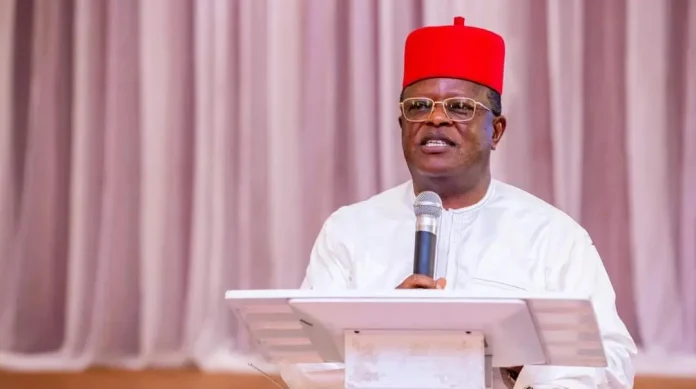
The Minister of Works, David Umahi, has defended the Federal Government’s borrowing strategy, stating that President Bola Tinubu is taking loans to finance road infrastructure considered critical to national development.
Umahi made the remarks in Abuja during a visit by the Inspector-General of Police, Olatunji Disu, to the Ministry of Works.
According to him, infrastructure development—particularly road construction—is essential to security operations, economic activities and national productivity.
“When people say, ‘Why is he borrowing?’ the President is borrowing so that our roads can be good. Without roads, it’s difficult for security agencies. Without roads, commerce cannot thrive, and schools will be hindered,” Umahi said.
The minister explained that more than 80 per cent of ongoing road projects, valued at about N34 trillion, were inherited from previous administrations spanning several years, adding that the current administration chose to retain them due to their strategic importance.
He also noted that the government has adopted reinforced concrete pavement technology to ensure durability, stressing that completed roads are expected to last between 50 and 100 years without major repairs.
Among the Tinubu administration’s flagship infrastructure projects are the Lagos–Calabar Coastal Highway, Sokoto–Badagry Highway, Calabar–Ebonyi–Benue–Kogi–Nasarawa–Abuja corridor, and the Akwanga–Jos–Bauchi–Gombe–Biu–Maiduguri route.
Umahi disclosed that Section One of the 47.47-kilometre Lagos–Calabar Coastal Highway has been completed and is already attracting investor interest for tolling arrangements.
He also revealed that solar lighting has been approved for the 375-kilometre Abuja–Kaduna–Zaria–Kano highway, with 118 kilometres already completed at a cost of N252 billion. The second phase of 164 kilometres is expected to be delivered by November.
Meanwhile, data from the Debt Management Office (DMO) shows that Nigeria’s external debt rose significantly in 2025 amid continued borrowing for infrastructure and fiscal support.
According to the figures, Nigeria’s total external debt stood at $51.86 billion as of December 2025, representing a 13.27 per cent increase from $45.78 billion recorded in December 2024.
Between September and December 2025 alone, external debt increased from $48.46 billion to $51.86 billion, indicating sustained borrowing activity and exchange rate-related adjustments.
This Video Is Trending Right Now 👇
Nigeria’s external debt stock remains concentrated among major international creditors, including Eurobond investors, the International Development Association (IDA) of the World Bank, the African Development Bank (AfDB), and the International Bank for Reconstruction and Development (IBRD).
The issues
Nigeria’s rising debt profile continues to raise concerns among economists and policy analysts, particularly regarding debt sustainability, fiscal transparency and long-term repayment obligations.
While government officials argue that borrowing is necessary to bridge infrastructure gaps, critics warn that increasing debt without corresponding revenue growth could strain future budgets.
The debate also reflects broader tensions between infrastructure-driven borrowing and concerns over inflation, exchange rate pressure and rising cost of governance.
What’s being said
The Works Minister insists that borrowing is justified because infrastructure development remains central to economic transformation, security and national integration.
He maintains that ongoing road projects are designed as long-term investments that will generate economic value over time through improved connectivity and private sector participation.
Economic data from the DMO shows continued reliance on external financing from multilateral institutions and international investors to support government expenditure.
What’s next
The Federal Government is expected to continue funding major infrastructure projects through a mix of borrowing, public-private partnerships and potential tolling arrangements.
Attention is likely to intensify around debt sustainability discussions as Nigeria’s borrowing trajectory continues to rise.
Stakeholders are also expected to monitor the completion timelines and economic returns of flagship road projects across the country.
Bottom line
The Tinubu administration maintains that borrowing for infrastructure is necessary for long-term development, particularly in road construction. However, Nigeria’s rising external debt to $51.86 billion continues to fuel debate over fiscal sustainability and the balance between development financing and debt management.
For more Naija celebrity news and updates, keep following Gist News for the latest Naija celebrity news and trends in Newspaper Nigeria Headlines.
Naija gist news
latest Naija gist
Naija news live